


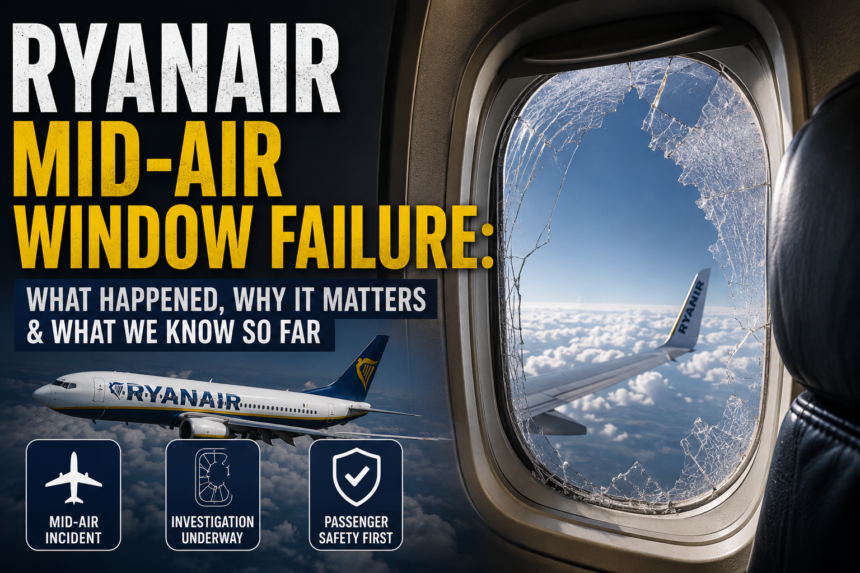
Introduction
Few aviation incidents capture global attention like a cabin window failure during flight. The recent Ryanair mid-air window failure became international news after a passenger was reportedly pulled partway toward a shattered window following an in-flight emergency on a Boeing 737 shortly after departure from Thessaloniki, Greece.
While early social media posts described the event as a “window blowing out,” investigators are examining a more complex sequence of events. Preliminary information indicates that an apparent engine malfunction may have sent debris toward the aircraft, damaging a passenger window and triggering rapid cabin depressurization. The flight crew declared an emergency, safely returned to the departure airport, and emergency responders treated the injured passenger after landing.
Because official investigations are still ongoing, some widely circulated claims remain unconfirmed. This guide separates verified facts from speculation, explains how aircraft cabin windows are designed, summarizes passenger accounts, and explores what this incident could mean for airline safety.
Featured Snippet Answer
What happened in the Ryanair mid-air window failure?
A Ryanair-operated Malta Air Boeing 737 returned safely to Thessaloniki shortly after takeoff on July 10, 2026, after an in-flight emergency involving a damaged passenger window and rapid cabin depressurization. Preliminary reports suggest an apparent engine failure may have caused debris to strike the window. The investigation remains ongoing.
Table of Contents
- What Happened in the Ryanair Mid-Air Window Failure?
- Timeline of the Incident
- How the Window Failed
- Passenger Accounts
- Flight Crew Response
- Aircraft Safety Systems Explained
What Happened in the Ryanair Mid-Air Window Failure?
The incident occurred aboard a Ryanair-operated Malta Air Boeing 737-800 traveling from Thessaloniki, Greece, to Memmingen, Germany. Shortly after takeoff, passengers reported hearing a loud bang before one of the cabin windows became severely damaged.
The event quickly escalated into a rapid cabin depressurization. Oxygen masks automatically deployed, and nearby passengers helped restrain a man seated next to the damaged window after he was pulled partially toward the opening by the pressure difference inside and outside the aircraft.
Although early reports focused on a “window failure,” investigators are also examining evidence of an apparent uncontained engine problem, which may have sent debris into the aircraft’s fuselage area. This distinction is important because the root cause may not have originated with the window itself.
Key Confirmed Facts
| Detail | Current Status |
| Aircraft | Boeing 737-800 (Malta Air operating for Ryanair) |
| Departure | Thessaloniki, Greece |
| Destination | Memmingen, Germany |
| Incident | Cabin window damaged during flight |
| Oxygen masks deployed | Yes |
| Emergency landing | Successful return to Thessaloniki |
| Passenger injured | Yes |
| Investigation | Ongoing |
Timeline of the Incident
Understanding the sequence of events helps explain why the crew’s response has received praise from aviation experts.
Before Departure
- Aircraft prepared for its scheduled Ryanair service.
- Flight departed Thessaloniki normally.
- Weather conditions were not initially reported as a contributing factor.
Shortly After Takeoff
Within minutes of departure, passengers described hearing a loud explosive noise. Soon afterward:
- The aircraft experienced an apparent engine issue.
- A passenger-side window was damaged.
- Cabin pressure rapidly decreased.
- Oxygen masks automatically deployed throughout the cabin.
Emergency Response
The flight crew:
- Declared an emergency.
- Began an emergency descent.
- Coordinated with air traffic control.
- Returned directly to Thessaloniki Airport.
Emergency vehicles were already positioned when the aircraft landed safely.
After Landing
Following landing:
- Medical personnel treated the injured passenger.
- Several passengers underwent precautionary medical evaluations.
- Ryanair arranged a replacement aircraft so most travelers could continue their journey.
How the Window Failed
One of the biggest questions surrounding this incident is whether the window itself failed or whether external damage caused the failure.
Based on currently available official information, investigators have not reached a final conclusion.
What Preliminary Reports Suggest
Early evidence indicates investigators are examining whether:
- an apparent engine malfunction occurred first,
- engine debris struck the aircraft,
- the impact shattered or dislodged the passenger window,
- rapid depressurization followed immediately afterward.
Why This Distinction Matters
If the investigation confirms debris caused the damage, the event would primarily involve an engine-related failure rather than a structural weakness in the cabin window.
Conversely, if investigators identify an independent window or fuselage defect, different safety recommendations could follow.
At the time of writing, no final accident report has been released, so any definitive claim about the exact cause would be premature.
Passenger Accounts
Passengers described a frightening but fast-moving emergency.
Several eyewitnesses reported:
- hearing a sudden loud bang,
- seeing oxygen masks deploy,
- feeling rapid pressure changes,
- witnessing fellow passengers hold onto the injured man,
- cabin crew issuing emergency instructions immediately.
According to multiple reports, the injured passenger’s head and shoulders were pulled toward the damaged window before nearby passengers and crew members managed to pull him safely back into the cabin. His seatbelt is believed to have helped prevent a more severe outcome.
Despite the frightening circumstances, the aircraft landed safely, preventing what could have become a far more serious accident.
Lessons From Passenger Testimony
Passenger accounts consistently highlight:
- The importance of wearing a seatbelt even when the seatbelt sign is off.
- Remaining calm and following crew instructions.
- The rapid response of nearby travelers and flight attendants.
Flight Crew Response
From an operational perspective, aviation specialists note that the crew’s actions closely matched standard emergency procedures for a suspected cabin depressurization.
Immediate Actions
The pilots reportedly:
- Recognized the emergency.
- Communicated with air traffic control.
- Initiated an emergency descent to a safer altitude.
- Turned the aircraft back toward Thessaloniki.
- Completed a safe landing.
Meanwhile, cabin crew members:
- Assisted passengers.
- Helped maintain order.
- Checked for injuries.
- Prepared the cabin for landing.
These actions likely reduced the overall risk during an extremely rare in-flight emergency.
Aircraft Safety Systems Explained
Modern commercial aircraft are designed with multiple layers of protection against cabin pressure emergencies.
Cabin Pressurization
Because cruising aircraft fly at altitudes where outside air pressure is too low for comfortable breathing, the cabin is pressurized to create a safer environment for passengers.
If pressure changes suddenly:
- oxygen masks deploy automatically,
- pilots descend rapidly to breathable altitude,
- emergency procedures begin immediately.
This sequence is standard across modern commercial aviation.
Why Windows Have Multiple Layers
Passenger windows are not made from a single sheet of glass. Instead, they contain multiple transparent layers designed to:
- withstand repeated pressure cycles,
- tolerate significant stress,
- provide redundancy if one layer is damaged.
A severe external impact—such as high-energy engine debris—is a different scenario than ordinary cabin pressure and is one reason investigators are carefully examining the origin of the damage rather than assuming the window itself failed.
What Passengers Should Remember
If oxygen masks deploy:
- Put your own mask on first.
- Keep your seatbelt fastened.
- Stay seated unless instructed otherwise.
- Listen carefully to crew instructions.
- Avoid removing your mask until told it is safe.
These simple actions can significantly improve safety during a decompression event.
Investigation Updates
At the time of writing, the investigation into the Ryanair mid-air window failure remains active. Aviation authorities are working to determine the exact sequence of events, including whether the incident began with an engine malfunction, structural damage, or another mechanical issue.
Unlike many viral social media claims, investigators have not yet released a final accident report. This means several widely shared explanations remain unverified.
Agencies Involved
Depending on the aircraft registration, operator, and location of the incident, investigators may coordinate with multiple organizations, including:
- Greek aviation authorities
- The aircraft manufacturer
- The engine manufacturer
- European aviation safety officials
- Ryanair and Malta Air technical teams
These organizations typically examine:
- Flight Data Recorder (FDR)
- Cockpit Voice Recorder (CVR)
- Aircraft maintenance records
- Engine components
- Damaged fuselage sections
- Passenger window assembly
- Air traffic control communications
A complete technical investigation often takes several months before a final report is published.
What Has Been Confirmed So Far
| Investigation Area | Current Status |
| Aircraft landed safely | ✅ Confirmed |
| Passenger injured | ✅ Confirmed |
| Cabin depressurization | ✅ Confirmed |
| Window damage | ✅ Confirmed |
| Engine-related damage being examined | ✅ Under Investigation |
| Final root cause identified | ❌ Not Yet |
Why Official Reports Matter
Early eyewitness accounts are valuable but don’t always explain why an incident occurred.
For example:
- A loud explosion could originate from an engine.
- A damaged window could be a consequence—not the initial failure.
- Cabin depressurization is often the result of another mechanical event.
This is why aviation investigators rely on physical evidence rather than public speculation.
Possible Causes
Several possible scenarios are being examined. Importantly, none should be considered confirmed until investigators publish their findings.
1. Engine Failure
This is currently one of the leading possibilities discussed in preliminary reporting.
If an engine component failed at high speed, debris could have:
- struck the fuselage,
- damaged the cabin window,
- caused rapid depressurization.
Modern jet engines are designed to contain internal failures whenever possible, but rare “uncontained engine failures” have occurred in aviation history.
2. Impact From External Debris
Investigators are also examining whether an object originating outside the aircraft struck the fuselage.
Possible examples include:
- engine fragments,
- runway debris (less likely after takeoff),
- unidentified foreign objects.
No official confirmation has been released regarding this possibility.
3. Structural Damage
Another possibility involves structural damage around the window frame or fuselage.
Aircraft undergo thousands of pressurization cycles throughout their service lives.
Maintenance inspections are designed to identify:
- corrosion,
- fatigue cracks,
- seal deterioration,
- structural weaknesses.
At present, investigators have not indicated that structural fatigue caused this incident.
4. Window Assembly Failure
Passenger windows are engineered with multiple layers and strict certification standards.
Although investigators will inspect the window assembly carefully, there is currently no verified evidence that a manufacturing defect or standalone window failure was responsible.
Could Multiple Factors Be Involved?
Yes.
Many aviation accidents involve a chain of events rather than a single failure.
For example:
Engine malfunction → debris strikes fuselage → window damage → depressurization → emergency descent.
Determining the exact sequence is one of the primary goals of the investigation.
Aviation Expert Analysis
Aviation safety specialists often emphasize that rare emergencies provide valuable opportunities to improve future safety standards.
Why This Incident Is Unusual
Complete cabin window failures on modern commercial aircraft are extremely rare.
Passenger windows undergo rigorous certification involving:
- pressure testing,
- impact testing,
- temperature testing,
- repeated fatigue cycles.
Because of these standards, investigators are unlikely to assume the window itself failed without supporting evidence.
Importance of the Emergency Descent
Following depressurization, pilots typically perform an emergency descent to reach an altitude where passengers can breathe without supplemental oxygen.
This procedure is practiced repeatedly during simulator training.
Experts note that rapid but controlled descents are a standard response—not a sign of panic.
Human Factors
Passenger behavior also influences emergency outcomes.
Safety experts consistently recommend:
- wearing seatbelts whenever seated,
- listening to cabin crew,
- avoiding unnecessary movement,
- remaining calm.
The reported use of seatbelts during this incident may have significantly reduced injuries.
Lessons for Airlines
Although investigations continue, aviation professionals may eventually evaluate whether:
- inspection procedures require updates,
- maintenance intervals should change,
- engineering improvements are possible,
- crew training can be enhanced further.
Aircraft Window Design Explained
Many travelers assume airplane windows are made from ordinary glass.
In reality, modern commercial aircraft use sophisticated multi-layer transparent panels engineered specifically for high-altitude flight.
How Many Layers Are There?
A typical passenger window includes:
- Outer structural pane
- Middle fail-safe pane
- Inner cabin pane (protective layer)
Each layer serves a different purpose.
Why Multiple Layers?
The layered design provides redundancy.
If one layer becomes damaged, other layers continue protecting the cabin.
This significantly reduces the likelihood of catastrophic failure.
Small Bleed Hole Explained
Most passenger windows include a tiny hole in the inner pane.
This often surprises travelers.
The hole helps:
- regulate pressure between layers,
- reduce moisture buildup,
- prevent fogging.
It does not weaken the window.
Can Aircraft Fly With Damaged Windows?
It depends entirely on:
- which layer is damaged,
- severity of damage,
- cabin pressure integrity,
- airline maintenance procedures.
Pilots are trained to respond conservatively whenever structural integrity is questioned.
Safety Procedures During Cabin Depressurization
Rapid depressurization is one of the emergencies commercial pilots regularly train for.
Although dramatic, established procedures are designed to maximize passenger survival.
What Happens Automatically?
Within seconds:
- Oxygen masks deploy.
- Pilots receive cockpit alerts.
- Emergency checklists begin.
- Air traffic control is notified.
Pilot Priorities
Pilots generally focus on:
- Flying the aircraft.
- Restoring a safe environment.
- Communicating with ATC.
- Diverting if necessary.
Aviation training often summarizes this sequence as:
Aviate → Navigate → Communicate
Cabin Crew Responsibilities
Flight attendants typically:
- reassure passengers,
- assist injured travelers,
- verify oxygen mask use,
- prepare the cabin,
- coordinate with pilots.
Passenger Responsibilities
Passengers should:
- immediately secure their own oxygen mask,
- fasten seatbelts,
- remain seated,
- avoid opening overhead bins,
- wait for crew instructions.
These actions help reduce injuries during sudden altitude changes.
Comparison with Similar Aviation Incidents
Although extremely uncommon, cabin depressurization incidents have occurred before.
| Incident | Primary Cause | Outcome |
| Southwest Flight 1380 (2018) | Engine failure causing window damage | Emergency landing |
| British Airways Flight 5390 (1990) | Windshield failure | Safe landing |
| Aloha Airlines Flight 243 (1988) | Structural fatigue | Emergency landing |
| Ryanair Mid-Air Window Failure (2026) | Investigation ongoing | Safe emergency landing |
What Makes the Ryanair Case Different?
Unlike several previous accidents where the cause was established relatively quickly, investigators are still determining:
- whether engine damage occurred first,
- whether debris struck the aircraft,
- whether window damage was secondary.
This distinction could influence future maintenance recommendations.
What Passengers Should Do in an Emergency
Knowing how to respond can significantly improve safety.
Before Every Flight
✔ Wear your seatbelt whenever seated.
✔ Pay attention to the safety briefing.
✔ Locate the nearest emergency exit.
✔ Read the safety card.
During Cabin Depressurization
Immediately:
- Put on your oxygen mask.
- Tighten your seatbelt.
- Stay seated.
- Help children only after securing your own mask.
- Listen to flight attendants.
After Landing
Remain seated until instructed.
Emergency responders may board first to assist injured passengers.
Avoid rushing toward exits unless evacuation is ordered.
Common Myths vs Facts
| Myth | Fact |
| Airplane windows are made from ordinary glass. | Modern aircraft use multiple engineered layers. |
| Oxygen masks provide unlimited oxygen. | They provide oxygen long enough for pilots to descend to a safer altitude. |
| Cabin depressurization always causes an aircraft to crash. | Modern aircraft are designed and crews are trained to manage this emergency safely. |
| Window failures are common. | They are extremely rare in commercial aviation. |
| You can ignore your seatbelt once the sign turns off. | Keeping it fastened while seated is strongly recommended. |
Key Takeaways
What We Know
- A Ryanair-operated Malta Air Boeing 737 experienced an in-flight emergency.
- A passenger window was damaged.
- Cabin depressurization occurred.
- Oxygen masks deployed automatically.
- The aircraft returned safely.
- One passenger sustained injuries.
- Investigators continue examining the root cause.
What We Don’t Yet Know
- The confirmed cause of the damage.
- Whether engine failure initiated the event.
- Whether structural issues contributed.
- Whether maintenance recommendations will change.
Until the final investigation is released, any definitive explanation would be speculative.
Pros & Cons of Current Aviation Safety Systems
| Pros | Cons |
| Multiple layers of aircraft safety | Rare failures can still occur |
| Highly trained flight crews | Investigations can take months |
| Advanced pressurization systems | Initial reports may create confusion |
| Automatic oxygen deployment | Passenger panic remains a challenge |
| Strict aircraft maintenance standards | Mechanical failures cannot be eliminated entirely |
| International safety oversight | Public misinformation spreads quickly online |
Latest Official Statements
As of publication, Ryanair has confirmed that the aircraft returned safely to Thessaloniki Airport after an in-flight emergency involving a damaged passenger window. The airline stated that the crew followed established emergency procedures, the aircraft landed safely, and the injured passenger received medical attention after landing.
Ryanair CEO Michael O’Leary later said that preliminary indications suggested the event may have involved foreign object damage affecting the engine, but he emphasized that this was not a definitive conclusion and that investigators would determine the final cause.
Meanwhile, investigators have cautioned against drawing early conclusions. The U.S. National Transportation Safety Board (NTSB), which is participating in the investigation, has stated that possible contributing factors—including aircraft age, maintenance history, and engine-related issues—remain under review. No final accident report has been issued yet.
Current Official Position
| Topic | Current Status |
| Emergency landing | ✅ Confirmed |
| Passenger injuries | ✅ Confirmed |
| Cabin depressurization | ✅ Confirmed |
| Window damage | ✅ Confirmed |
| Exact root cause | ⏳ Still under investigation |
| Final investigation report | Not yet published |
Frequently Asked Questions (FAQs)
1. What is the Ryanair mid-air window failure?
The Ryanair mid-air window failure refers to a July 2026 incident in which a passenger window on a Ryanair-operated Malta Air Boeing 737 was damaged shortly after takeoff from Thessaloniki, leading to rapid cabin depressurization and an emergency landing.
2. Was anyone seriously injured?
One passenger seated next to the damaged window sustained injuries after being partially pulled toward the opening. Reports indicate the injuries were serious but not life-threatening, and the passenger received hospital treatment.
3. Did the aircraft crash?
No. The pilots safely returned the aircraft to Thessaloniki Airport, where it landed without further incident.
4. What caused the window to fail?
The exact cause has not been officially confirmed. Investigators are examining whether an engine-related event caused debris to strike the aircraft, damaging the window.
5. Are airplane windows strong enough for normal flight?
Yes. Modern commercial aircraft windows are built with multiple reinforced layers and undergo extensive testing to withstand normal cabin pressurization and environmental conditions.
6. How rare are cabin window failures?
They are extremely rare. Commercial aviation records show that serious cabin window failures are uncommon compared with the millions of flights safely completed each year.
7. Why did oxygen masks deploy?
The masks deployed automatically because the aircraft experienced rapid cabin depressurization, reducing the amount of breathable oxygen inside the cabin.
8. What should passengers do if oxygen masks drop?
Passengers should immediately put on their own mask first, fasten their seatbelt, remain seated, and carefully follow instructions from the flight crew.
9. Is it safe to fly after this incident?
Commercial aviation remains one of the safest forms of transportation. A single incident does not indicate that all aircraft of the same type or airline are unsafe. Safety regulators investigate such events thoroughly before making recommendations.
10. Who is investigating the incident?
The investigation involves aviation authorities, technical specialists, and manufacturers. Public reports indicate that the NTSB is participating alongside other relevant authorities because of the aircraft and engine involved.
11. Could this happen again?
While no mechanical system is entirely risk-free, commercial aircraft are designed with multiple redundant safety systems, and lessons learned from investigations often lead to improved inspections, maintenance procedures, or engineering standards.
12. When will the final investigation report be released?
There is no confirmed publication date. Aviation investigations often take months, depending on the complexity of the evidence and technical analysis. Preliminary findings may be released earlier than the final report.
Expert Recommendations
Although incidents like this are exceptionally uncommon, aviation safety experts consistently recommend the following practices for passengers:
Before Takeoff
- Listen carefully to the safety demonstration.
- Locate your nearest emergency exit.
- Read the aircraft safety card.
- Keep your seatbelt fastened whenever you are seated.
During an Emergency
- Put on your oxygen mask immediately before assisting others.
- Remain calm and avoid unnecessary movement.
- Follow all instructions from the flight attendants.
- Leave carry-on baggage behind if an evacuation is ordered.
After the Flight
- Seek medical evaluation if you experienced significant pressure changes, ear pain, breathing difficulties, or physical injury.
- Rely on official investigation updates rather than unverified social media claims.
These simple actions can improve passenger safety during the rare occasions when an in-flight emergency occurs.
Internal Linking Suggestions
To strengthen topical authority and improve SEO, consider linking this article to related aviation and travel content on your website.
| Suggested Anchor Text | Related Topic |
| How airplane cabin pressurization works | Aviation safety guide |
| What causes aircraft emergency landings? | Aviation explainer |
| Boeing 737 safety features explained | Aircraft technology |
| How safe is commercial air travel? | Travel safety article |
| What happens during rapid decompression? | Emergency procedures |
| Best tips for nervous flyers | Passenger advice |
| Understanding airplane oxygen masks | Cabin safety |
| Most famous aviation incidents in history | Aviation history |
External Authority References
For readers who want verified technical information, these organizations are among the most authoritative sources:
- National Transportation Safety Board (NTSB)
- European Union Aviation Safety Agency (EASA)
- Federal Aviation Administration (FAA)
- Boeing
- CFM International
- Ryanair
When the final investigation is released, these organizations will be the most reliable sources for confirmed technical findings.
Final Conclusion
The Ryanair mid-air window failure is one of the most closely watched aviation incidents of 2026 because it combined a rare cabin depressurization event with a successful emergency landing that likely prevented a much greater tragedy.
While dramatic eyewitness accounts quickly spread online, the most important takeaway is that the investigation is still ongoing. Current evidence suggests investigators are examining the possibility that an engine-related event led to debris striking the aircraft, but no official report has confirmed the definitive cause.
The incident also highlights why commercial aviation remains remarkably safe. Modern aircraft incorporate redundant engineering, highly trained flight crews, automatic emergency systems, and rigorous international oversight. Even in rare emergencies, these layers of protection are designed to maximize passenger survival.
For readers, the practical lessons are straightforward:
- Always keep your seatbelt fastened while seated.
- Pay attention to the safety briefing before departure.
- Put on your oxygen mask immediately if it deploys.
- Wait for official investigation findings before accepting online speculation.
As investigators continue their work, this article will be updated to reflect any confirmed developments.