


Introduction
The Game retailer administration collapse marks one of the biggest developments in the UK video game retail industry in recent years. For decades, GAME was a familiar destination for gamers looking to buy new releases, consoles, accessories, and collectibles. Game retailer administration collapse
However, changing consumer habits, financial pressure, and a rapidly evolving gaming market eventually pushed the retailer into administration.
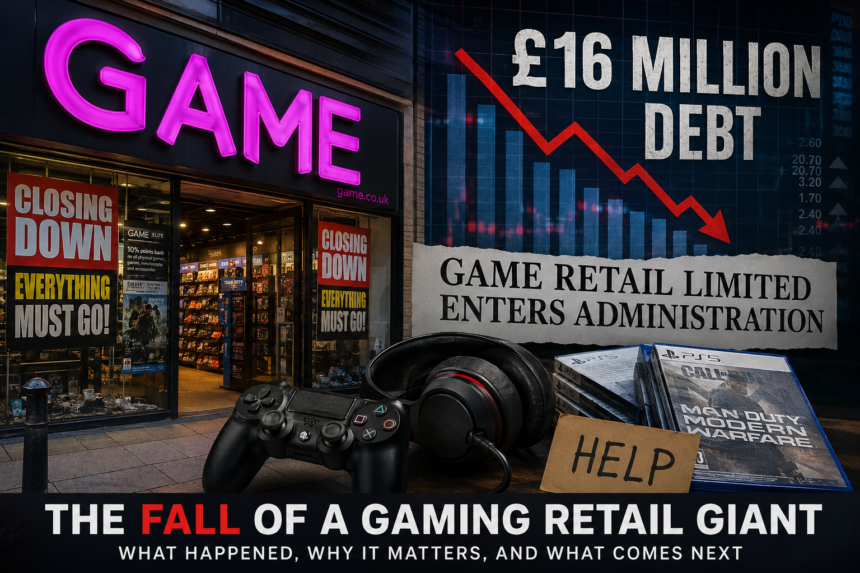
In 2026, GAME Retail Limited officially entered administration after accumulating nearly £16 million in debt, highlighting the growing challenges faced by traditional brick-and-mortar gaming retailers. While the GAME brand still operates online and through concession stores within Frasers Group locations, the administration of GAME Retail Limited represents the end of an important chapter in UK high-street gaming retail. (Find and Update Company Information)
This article explains what happened, why it happened, how it affects customers, employees, suppliers, and the wider gaming industry, and what lessons other retailers can learn.
What Is the Game Retailer Administration Collapse?
Featured Snippet Answer
The Game retailer administration collapse refers to the financial failure of GAME Retail Limited, which entered administration in February 2026 after building up almost £16 million in liabilities. The administration affects the legal company responsible for parts of the retail business, GAME Retail Limited administration while the GAME brand continues operating online and through concession stores under another Frasers Group company. (Find and Update Company Information)
Many people initially assumed that the GAME brand had disappeared completely. That isn’t entirely accurate.
Instead, it is important to distinguish between:
| GAME Retail Limited | GAME Brand |
| Entered administration | Continues trading online |
| Responsible for debts | Operates through Sports Direct concessions |
| Insolvent legal company | Still serves customers in selected locations |
This distinction is often misunderstood but is essential for understanding the situation correctly. (Gaming Clickdo)
What Does Administration Mean?
Administration is a legal process designed to protect a financially distressed company while licensed insolvency practitioners evaluate the best way forward.
The primary objectives are:
- Protect the company from immediate creditor action.
- Attempt to rescue the business if possible.
- Achieve a better outcome for creditors than immediate liquidation.
- Sell assets where necessary.
- Maximize returns for creditors.
Administration does not automatically mean a business closes forever.
Sometimes companies:
- Continue trading.
- Sell profitable divisions.
- Restructure operations.
- Return as smaller businesses.
That is why customers may still see the GAME brand despite GAME Retail Limited entering administration. (Find and Update Company Information)
Overview of GAME Retail Limited
For many years, GAME was synonymous with video game retail in the United Kingdom.
At its peak, the retailer operated hundreds of stores across the country and became the go-to destination for:
- Video games
- Gaming consoles
- PC accessories
- Gaming headsets
- Collectibles
- Pre-owned games
- Trade-in services
The company expanded significantly after acquiring GameStation, strengthening its presence on UK high streets. However ,GAME Retail Limited administration as the gaming market shifted toward digital distribution, the traditional retail model became increasingly difficult to sustain. (Nintendo Life)
Timeline of the Game Retailer Administration Collapse
Understanding the sequence of events provides valuable context.
| Year | Major Event |
| 2012 | GAME previously entered administration before later restructuring. |
| 2019 | Frasers Group acquired GAME’s parent company. |
| 2020–2025 | Standalone stores were gradually reduced as operations shifted toward concession formats. |
| February 2026 | GAME Retail Limited entered administration. |
| July 2026 | Administrators reported liabilities of nearly £16 million. (Retail Gazette) |
This gradual decline illustrates that the collapse was not caused by a single event but by years of mounting pressure.
Why Did GAME Enter Administration?
No single factor caused the collapse.
Instead, several long-term trends combined to create an increasingly difficult business environment.
Shift Toward Digital Gaming
Perhaps the biggest challenge was the industry’s transition from physical game discs to digital downloads.
Modern gamers increasingly purchase games through online platforms rather than visiting physical stores.
Major platforms include:
- PlayStation Store
- Xbox Store
- Nintendo eShop
- Steam
- Epic Games Store
As digital sales grew, fewer customers needed to visit specialist retailers.
Administrators specifically identified the transition from physical games to digital downloads as a key reason for the company’s financial difficulties. (Retail Gazette)
Increasing Competition
GAME also faced intense competition from:
- Online marketplaces
- Large supermarkets
- Electronics retailers
- E-commerce platforms
- Digital storefronts
Customers could often compare prices instantly and choose whichever option offered the best value.
This reduced the competitive advantage that specialist gaming stores once enjoyed.
Declining Foot Traffic
High streets across the UK have experienced reduced customer visits for years.
Many shoppers now prefer:
- Online shopping
- Home delivery
- Click-and-collect services
Lower store traffic means lower sales while fixed operating costs—such as rent, utilities, and staffing—remain high.
Brexit-Related Economic Pressure
Administrators also referenced uncertainty linked to Brexit as one of several factors that created a more difficult trading environment.
While Brexit was not the sole cause, it added pressure alongside changing consumer behavior and stronger competition. (AOL)
Lack of Major Console Releases
The administration report also noted that the absence of major console launches over several years reduced excitement in the physical retail market.
Historically, new console launches generated:
- Long customer queues
- Strong accessory sales
- Higher foot traffic
- Increased software purchases
Without frequent hardware launches, retailers lost one of their strongest sales drivers. (Nintendo Life)
Financial Challenges Behind the Collapse
According to administrators’ reports, GAME Retail Limited entered administration owing approximately £15.8–£16 million.
The liabilities included:
- Around £3.35 million owed to secured creditors.
- Approximately £12 million owed to unsecured creditors.
These figures demonstrate the scale of the company’s financial difficulties and explain why administration became necessary. (Nintendo Life)
Key Takeaways
- GAME Retail Limited entered administration in February 2026.
- The company owed almost £16 million.
- Digital game downloads significantly reduced physical game sales.
- Competition from online retailers intensified financial pressure.
- Brexit-related uncertainty contributed to a challenging trading environment.
- The GAME brand continues to operate online and through concession stores despite the administration of GAME Retail Limited. (Find and Update Company Information)
Impact on Customers
One of the first questions many gamers asked after hearing about the Game retailer administration collapse was whether they could still buy games, redeem gift cards, or receive orders.
The good news is that the administration of GAME Retail Limited does not automatically mean the GAME brand has disappeared. Because the brand continues to operate under the wider Frasers Group structure, many services remain available through the official website and concession stores located inside Sports Direct and other Frasers-owned retail outlets. Game retailer administration collapse
However, customers should always check the latest announcements regarding returns, warranties, and gift card policies, as these can change during insolvency proceedings.
What Customers Should Know
| Customer Concern | Current Situation |
| Online shopping | Continues through the GAME website. |
| Physical stores | Many standalone stores have closed, while concession stores continue operating. |
| Gift cards | Customers should verify current acceptance policies before making purchases. |
| Returns and exchanges | Policies may vary depending on the retailer and purchase date. |
| Warranty claims | Manufacturer warranties generally remain valid where applicable. |
Although the GAME brand continues trading, the administration process may still affect certain customer services linked to the insolvent company.
How Employees Were Affected
Retail administrations often create uncertainty for employees, and the situation surrounding GAME Retail Limited was no exception.
When a company enters administration, administrators review every part of the business to determine whether operations can continue, be restructured, or sold Game retailer administration collapse
. During this process, staffing requirements may change depending on store performance and business needs.
Some employees had already experienced changes before the administration as the business shifted away from standalone GAME stores toward concession locations inside Sports Direct stores.
For workers, the biggest concerns typically include:
- Job security
- Future employment opportunities
- Outstanding wages
- Pension arrangements
- Redundancy rights
Employment outcomes differ depending on each employee’s circumstances and the decisions made by administrators .Game retailer administration collapse
Employee Challenges During Administration
Retail employees commonly face several challenges during administration:
- Uncertainty about future employment.
- Possible transfers to new business structures.
- Store closures affecting local jobs.
- Changes in working hours. Game retailer administration collapse
- Delays in employment decisions while administrators review operations.
Despite these concerns, administration aims to preserve as many viable jobs as possible where financially practical.
What Happened to Suppliers and Creditors?
Suppliers are often among the most affected stakeholders when a retailer enters administration.
GAME Retail Limited reportedly owed money to both secured and unsecured creditors, including suppliers that had provided products and services before the administration process began.
Types of Creditors
| Creditor Type | Description |
| Secured creditors | Lenders with security over company assets. |
| Unsecured creditors | Suppliers, service providers, and other businesses without secured claims. |
| Employees | May have claims relating to unpaid wages or redundancy. |
| Government agencies | Potential tax-related claims where applicable. |
Because secured creditors generally have priority during insolvency proceedings, Game retailer administration collapse
unsecured creditors may recover only part of the money owed—or, in some cases, none at all.
This is one of the most challenging aspects of retail administrations.
The Role of Frasers Group
A key point that many news reports emphasized is that GAME Retail Limited and the GAME brand are not exactly the same thing.
After Frasers Group acquired GAME’s parent business in 2019, it gradually changed the retailer’s operating model.
Instead of relying heavily on standalone stores, the company introduced GAME concession areas inside Sports Direct locations.
This strategy helped reduce operating costs while keeping the brand visible to customers.
Why the Concession Model Matters
Traditional standalone stores involve expenses such as:
- Separate rent
- Individual utility bills
- Dedicated staffing
- Store maintenance
- Business rates
By operating inside existing Sports Direct stores, many of these costs can be shared, making the business more efficient.
Although GAME Retail Limited entered administration, Game retailer administration collapse
the concession model allows the GAME brand to continue serving customers in many locations.
Why Physical Game Retailers Are Struggling
The administration of GAME Retail Limited reflects broader trends affecting physical game retailers around the world.
Several industry changes have transformed how consumers buy games.
1. Digital Downloads
Today’s players increasingly purchase games digitally instead of buying physical discs.
Benefits include:
- Instant downloads
- No shipping delays
- Automatic updates
- Digital libraries
- Frequent online discounts
As digital purchasing becomes more popular, Game retailer administration collapse
demand for physical retail stores naturally declines.
2. Subscription Services
Gaming subscription platforms have changed purchasing habits.
Popular examples include:
- Xbox Game Pass
- PlayStation Plus
- EA Play
- Ubisoft+
Instead of purchasing individual games, many players now subscribe to large game libraries for a monthly fee.
This reduces the number of physical game purchases made each year.
3. Online Shopping
Consumers increasingly compare prices across multiple online retailers before making purchases.
Advantages include:
- Competitive pricing
- Fast delivery
- Customer reviews
- Convenience
- Frequent promotional offers
Traditional retailers must compete against both specialist gaming stores and major e-commerce platforms.
Comparison with Other UK Retail Collapses
GAME Retail Limited is not the only well-known UK retailer to face financial difficulties.
Several high-street businesses have entered administration over the past decade due to changing consumer behavior and rising operating costs.
| Retailer | Industry | Main Challenge |
| GAME Retail Limited | Video Games | Digital downloads and reduced physical sales |
| Debenhams | Department Store | Online competition and declining footfall |
| Wilko | Home & Garden | Rising costs and cash flow issues |
| Comet | Electronics | Intense competition and changing shopping habits |
| BHS | Department Store | Financial difficulties and declining sales |
Although each case is different, common themes include:
- Increasing online competition
- Higher operating costs
- Changing customer preferences
- Economic uncertainty
- Reduced high-street traffic
These trends continue to reshape the retail sector.
Expert Analysis: Was the Collapse Inevitable?
Industry experts generally agree that the challenges facing specialist video game retailers have been building for many years.
The shift toward digital gaming has fundamentally changed consumer behavior.
Retailers that once relied on selling physical game discs now face competition from digital storefronts offering instant access to games without requiring customers to visit a store.
At the same time, subscription services and online marketplaces have reduced dependence on traditional retail channels.
This doesn’t necessarily mean physical game retail has no future. Instead, Game retailer administration collapse
many experts believe retailers must evolve by offering:
- Exclusive merchandise
- Gaming collectibles
- Community events
- Console demonstrations
- Trade-in programs
- Premium customer experiences
Retailers that provide experiences—not just products—may be better positioned to succeed in the years ahead.
Lessons Businesses Can Learn
The Game retailer administration collapse offers valuable lessons for businesses across the retail industry.
Key Business Lessons
- Adapt quickly to changing consumer behavior.
- Invest in digital transformation.
- Diversify revenue streams.
- Reduce unnecessary operating costs.
- Focus on customer experience.
- Monitor cash flow carefully.
- Respond proactively to market trends.
Companies that fail to evolve alongside technological changes may find it increasingly difficult to remain competitive.
Summary Box
Key Insight:
The collapse of GAME Retail Limited was not caused by a single event. Instead, it resulted from years of market changes, including the rise of digital gaming, stronger online competition, Game retailer administration collapse
declining high-street foot traffic, and ongoing financial pressures. While the legal company entered administration, the GAME brand continues operating through a revised retail model.
The Future of the GAME Brand
Although GAME Retail Limited entered administration, the GAME brand itself has not completely disappeared. Instead, it continues operating through Frasers Group’s retail network, Game retailer administration collapse
particularly within Sports Direct stores and its online platform.
This business model reflects a broader retail trend where brands reduce the cost of maintaining standalone stores while continuing to reach customers through shared retail spaces.
The future of the GAME brand will likely depend on several key factors:
- Continued demand for physical gaming products.
- Growth in gaming collectibles and merchandise.
- Success of concession stores.
- Consumer preference for in-store shopping versus digital purchases.
- Future console launches that drive customer traffic.
Rather than returning to its previous high-street presence, Game retailer administration collapse
industry analysts believe GAME is more likely to focus on a leaner and more cost-effective retail strategy.
What the Collapse Means for the UK Gaming Industry
The Game retailer administration collapse is more than the story of one company. It reflects the ongoing transformation of the gaming industry.
Over the last decade, gaming has shifted dramatically from physical media to digital ecosystems. This change has affected publishers, retailers, distributors, and consumers alike.
Several long-term trends are shaping the industry:
Growth of Digital Distribution
Digital storefronts now account for a significant share of game sales.
Benefits include:
- Instant downloads
- Automatic updates
- Cloud saves
- Digital libraries
- No physical inventory
As internet speeds improve and storage capacity increases, Game retailer administration collapse
digital purchasing is expected to remain the preferred option for many players.
Expansion of Subscription Gaming
Subscription services have changed how people access games.
Instead of purchasing individual titles, many players now pay a monthly fee for access to hundreds of games.
This shift reduces reliance on physical retailers while providing consumers with greater flexibility.
Collectibles Still Drive Physical Retail
Although physical game sales have declined, there is still demand for:
- Collector’s editions
- Gaming merchandise
- Action figures
- Trading cards
- Limited-edition consoles
- Accessories
These categories may become increasingly important for specialist gaming retailers.
Pros and Cons of Physical Game Retail
| Pros | Cons |
| Hands-on shopping experience | Declining physical game sales |
| Immediate product availability | Higher operating costs |
| Expert staff recommendations | Strong online competition |
| Trade-in opportunities | Reduced high-street foot traffic |
| Exclusive collectibles | Growth of digital downloads |
Retailers that balance physical products with digital services may have a stronger chance of long-term success.
Common Myths About the Game Retailer Administration Collapse
Many misconceptions circulated after news of the administration became public. Game retailer administration collapse
Here are some of the most common myths.
Myth 1: GAME Completely Shut Down
Fact: The legal company entered administration, but the GAME brand continues to trade through online services and concession stores.
Myth 2: Customers Automatically Lost All Rights
Fact: Consumer rights depend on the type of purchase, payment method, Game retailer administration collapse
warranty, and the retailer’s current policies. Customers should always check the latest official guidance.
Myth 3: Administration Means Immediate Liquidation
Fact: Administration is a legal process aimed at rescuing or restructuring a business where possible. Game retailer administration collapse
Liquidation is a separate insolvency process.
Myth 4: Physical Gaming Is Dead
Fact: While digital gaming dominates, demand remains for collector’s editions, merchandise, accessories, and certain physical releases.
Practical Lessons for Retail Businesses
The experience of GAME Retail Limited offers valuable lessons for businesses operating in fast-changing markets.
1. Embrace Digital Transformation
Businesses should adapt quickly to changing consumer preferences instead of relying solely on traditional sales models.
2. Diversify Revenue Streams
Offering additional products and services can reduce dependence on a single source of income.
3. Improve Customer Experience
Exceptional customer service, loyalty programs, and exclusive products can help businesses remain competitive.
4. Control Operating Costs
Regularly reviewing expenses, optimizing store networks, and improving operational efficiency can strengthen long-term sustainability.
5. Monitor Market Trends
Businesses that identify industry changes early are better positioned to respond before financial challenges become critical.
Key Takeaways
- GAME Retail Limited entered administration after significant financial difficulties.
- The company reportedly owed close to $16 million in liabilities.
- The GAME brand continues operating through Frasers Group’s concession-store model and online platform.
- Digital downloads, subscription services, changing shopping habits, Game retailer administration collapse
v and rising operating costs all contributed to the company’s challenges. - The case highlights the importance of innovation, cost management, and adapting to changing consumer behavior.
Conclusion
The Game retailer administration collapse illustrates how rapidly the retail and gaming industries have evolved. Specialist stores that once dominated the high street now face intense competition from digital marketplaces, subscription services, and changing customer expectations.
Although the administration of GAME Retail Limited marks the end of one part of the company’s history, the GAME brand continues to operate in a different form. Its evolution demonstrates that businesses can survive industry disruption by adapting their operating models rather than relying on traditional approaches.
For retailers, the story serves as a reminder that long-term success depends on innovation, financial discipline, and a willingness to respond to changing market conditions. Game retailer administration collapse
For gamers, it reflects the broader shift toward digital entertainment while showing that physical gaming products and collectibles still have an important place in the market.
FAQs
What is the Game retailer administration collapse?
The Game retailer administration collapse refers to the administration of GAME Retail Limited, a UK-based company that accumulated significant debt before entering formal insolvency proceedings.
Did the GAME brand shut down completely?
No. While GAME Retail Limited entered administration, the GAME brand continues to operate online and through concession stores within Frasers Group locations.
Why did GAME Retail Limited enter administration?
Several factors contributed, including declining physical game sales, increased digital downloads, stronger online competition, reduced high-street foot traffic, and financial pressures.
What does administration mean?
Administration is a legal insolvency process that protects a financially distressed company while administrators explore options to rescue, restructure, or sell the business.
Are GAME gift cards still valid?
Customers should check the latest information from the official GAME website, Game retailer administration collapse
as gift card and refund policies may change during administration.
How were employees affected?
Administration created uncertainty for employees, with staffing decisions depending on the administrators’ review of business operations and future viability.
What impact does this have on suppliers?
Suppliers may face delayed or partial repayments depending on their creditor status and the outcome of the administration process.
Is physical game retail disappearing?
Not entirely. While digital gaming continues to grow, physical products such as collector’s editions, accessories, and merchandise still attract many customers.
What lessons can businesses learn from this case?
Businesses should embrace digital transformation, diversify income sources, manage costs carefully, and adapt quickly to changing customer preferences.
Will the GAME brand continue in the future?
Although its traditional retail model has changed, the GAME brand is expected to continue through online channels and concession stores, subject to future business performance.